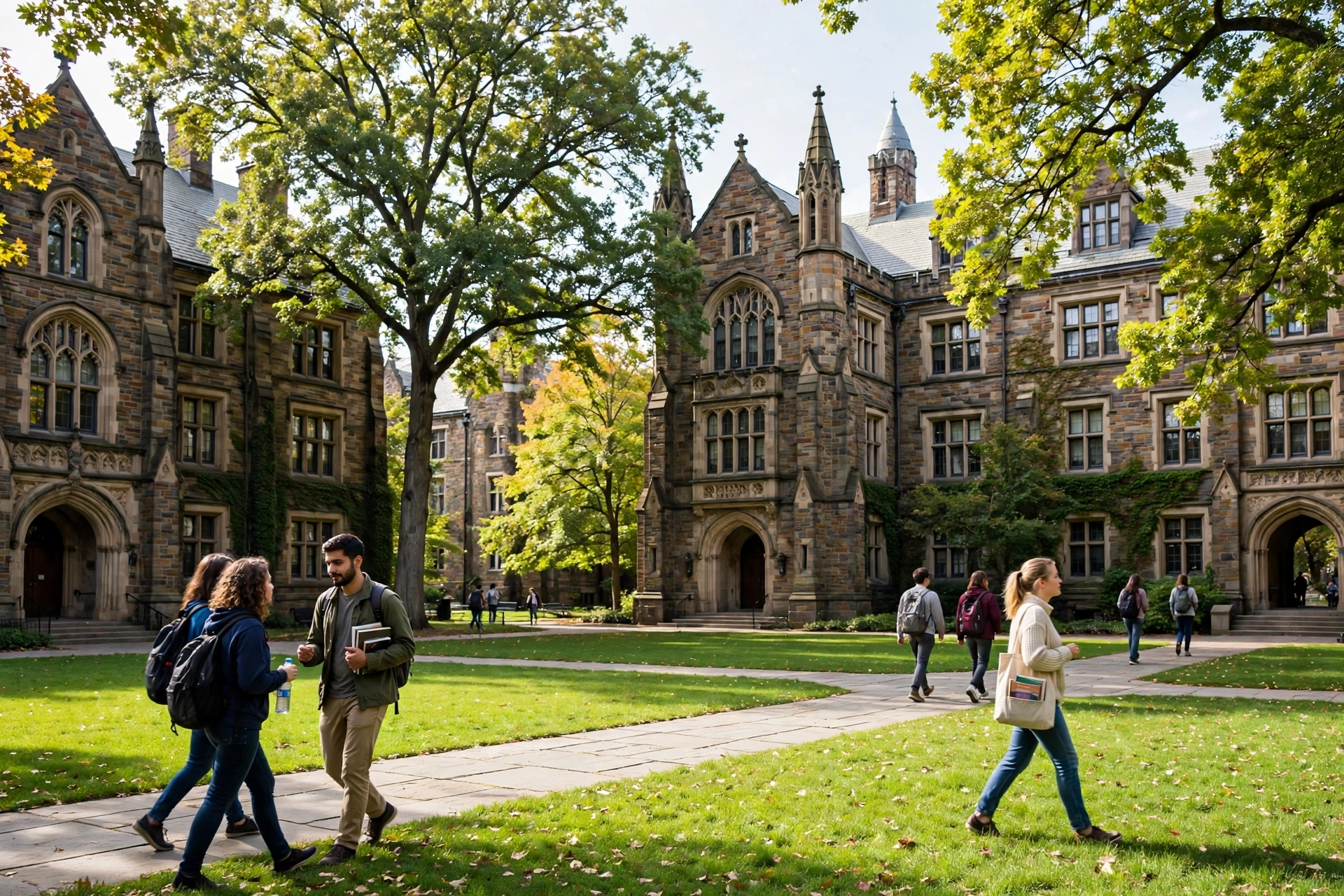
Choosing among the best universities in USA in 2026 is one of the biggest decisions a student can make. The United States is home to more than 4,000 colleges and universities, from small liberal arts colleges to huge public research universities and world-famous private institutions. The best universities in USA offer strong academics, generous financial aid, research opportunities, internships and a campus experience that can shape a career for decades. This guide explains the top national universities, their tuition, admission requirements and deadlines, and how to choose the right university for your goals, your budget and your major.
There is no single university that is best for everyone. A student who wants to study computer science may choose a different school from a student who wants to study medicine, business or engineering. Some students want a large campus in a major city, while others prefer a smaller college town. Some need generous scholarships, while others can pay full tuition. The best universities in USA for 2026 combine academic quality, student outcomes, affordability and support, and this article helps you compare them in a clear, honest way before you apply.
Rankings change a little every year, but the names at the top stay remarkably stable. Princeton, MIT, Harvard, Stanford, Yale, the University of Chicago, Columbia, the California Institute of Technology and the University of Pennsylvania regularly lead national rankings. Strong public universities such as the University of California, Berkeley, the University of California, Los Angeles, the University of Michigan, the University of Virginia and the University of North Carolina at Chapel Hill also compete with the best private universities. The list below gives a quick comparison, followed by detailed sections on each type of university, costs and admissions.
Top 10 Best Universities in USA 2026
The table below compares ten of the best universities in USA for 2026. Tuition figures are approximate annual tuition and fees for undergraduate study, before financial aid, and they can change each year. Many students pay much less than the published price after grants and scholarships, especially at universities with strong need-based aid. Acceptance rates are also approximate and vary by year, programme and applicant pool.
| University | Type | Location | Approx. Annual Tuition | Acceptance Rate |
|---|---|---|---|---|
| Princeton University | Private, Ivy League | Princeton, New Jersey | $62,400 | About 4% |
| Massachusetts Institute of Technology (MIT) | Private | Cambridge, Massachusetts | $61,990 | About 4% |
| Harvard University | Private, Ivy League | Cambridge, Massachusetts | $59,320 | About 3% |
| Stanford University | Private | Stanford, California | $65,910 | About 4% |
| Yale University | Private, Ivy League | New Haven, Connecticut | $67,250 | About 4% |
| University of Chicago | Private | Chicago, Illinois | $67,080 | About 5% |
| Columbia University | Private, Ivy League | New York City, New York | $68,000 | About 4% |
| University of California, Berkeley | Public | Berkeley, California | $15,800 in-state; $48,500 out-of-state | About 11% |
| University of California, Los Angeles (UCLA) | Public | Los Angeles, California | $14,000 in-state; $47,000 out-of-state | About 9% |
| University of Michigan, Ann Arbor | Public | Ann Arbor, Michigan | $17,800 in-state; $58,000 out-of-state | About 18% |
These figures show why the published price is only part of the story. A public university can cost less than half as much as a private university for in-state students, while a private university with generous aid can cost less than a public university for a low-income student. Always check the net price calculator on each university website. It estimates what a family like yours would actually pay after grants and scholarships, and it is far more useful than the headline tuition figure.
Ivy League Universities in USA
The Ivy League is a group of eight private universities in the north-eastern United States: Brown University, Columbia University, Cornell University, Dartmouth College, Harvard University, Princeton University, the University of Pennsylvania and Yale University. They are known for academic excellence, small classes, strong alumni networks and generous financial aid. Ivy League universities are among the most selective in the world, with acceptance rates usually between 3% and 9%, although Cornell and Dartmouth are slightly less selective than Harvard, Princeton and Columbia.
Princeton is often ranked first among national universities because of its undergraduate focus, small student-to-faculty ratio and strong financial aid. Harvard offers unmatched resources, libraries and global recognition, while Yale is famous for the humanities, law, drama and residential colleges. Columbia students benefit from a core curriculum and a campus in New York City. The University of Pennsylvania is strong in business through the Wharton School, as well as in nursing, medicine and engineering. Brown offers an open curriculum with unusual freedom to choose courses, Dartmouth is known for undergraduate teaching and a close community, and Cornell combines Ivy League academics with strong programmes in agriculture, engineering, hotel administration and veterinary medicine.
An Ivy League degree can open doors, but it is not the only route to success. Admission is extremely competitive, and many excellent students are not admitted. Students should apply to Ivy League universities only if their grades, test scores, essays and activities are strong, and they should also apply to other excellent universities where they have a realistic chance of admission and a good financial aid offer.
Top Public Universities in USA
Public universities offer some of the best value in American higher education. They are funded by state governments, so in-state students pay much lower tuition than out-of-state students. The best public universities in USA include the University of California, Berkeley and UCLA, the University of Michigan, the University of Virginia, the University of North Carolina at Chapel Hill, the University of Florida, the University of Texas at Austin, the University of Wisconsin-Madison, the University of Illinois Urbana-Champaign and the University of Washington.
Berkeley is world famous for research, computer science, engineering and economics, while UCLA is strong across almost every subject and offers a lively campus in Los Angeles. The University of Michigan combines strong academics with a famous sports culture and a large alumni network. The University of Virginia is known for its historic campus, business and public policy programmes, and the University of North Carolina at Chapel Hill offers strong value and a friendly college town. The University of Florida and the University of Texas at Austin have risen sharply in rankings in recent years, offering excellent programmes at relatively low in-state prices.
Public universities are usually larger than private universities, with more students, more majors and more clubs and activities. Class sizes can be larger in the first year, but honours programmes, research opportunities and smaller upper-level classes give motivated students close contact with professors. For many families, a top public university is the smartest choice: world-class teaching and research at a price that is much easier to afford.
Best Universities in USA by Major
The best universities in USA depend heavily on your major. A university that is number one overall may not be number one for your subject, and a university ranked 30th overall may be top five for engineering or nursing. Always compare departments, not just overall rankings. Look at faculty, research labs, internships, graduate outcomes and accreditation for your field.
Best Universities for Engineering
For engineering, MIT, Stanford, the California Institute of Technology, the University of California, Berkeley, the University of Michigan, Georgia Institute of Technology, Carnegie Mellon University, Purdue University and the University of Illinois Urbana-Champaign are among the strongest choices. MIT and Caltech are famous for research and innovation, while Georgia Tech and Purdue offer excellent engineering at lower public-university prices. Engineering students should look for ABET accreditation, co-op programmes, maker spaces, research labs and strong links with employers in aerospace, automotive, energy and technology.
Best Universities for Business
For business, the University of Pennsylvania (Wharton), MIT (Sloan), the University of California, Berkeley (Haas), the University of Michigan (Ross), New York University (Stern), the University of Texas at Austin (McCombs), the University of Virginia (McIntire), the University of North Carolina at Chapel Hill (Kenan-Flagler) and Cornell University are leading choices. Business students benefit from internships, case competitions, alumni networks and location: schools in New York, Chicago, San Francisco and Austin give easier access to finance, consulting, technology and start-up employers. Accreditation, career services and starting salaries after graduation are useful measures.
Best Universities for Medicine and Health
Medicine in the United States is a graduate programme, so undergraduate students first complete a pre-medical degree, usually in biology, chemistry or a related subject, then apply to medical school. The best universities for pre-medical students include Harvard, Johns Hopkins University, Stanford, Duke University, the University of Pennsylvania, Washington University in St. Louis, Cornell University, the University of California, Los Angeles and the University of Michigan. For medical school itself, Harvard, Johns Hopkins, Stanford, the University of Pennsylvania, Columbia, Duke, the University of California, San Francisco and the University of Washington are consistently ranked at the top. Strong pre-medical programmes offer hospital volunteering, research, advising and high medical school acceptance rates.
Best Universities for Computer Science
For computer science, Carnegie Mellon University, MIT, Stanford, the University of California, Berkeley, the University of Illinois Urbana-Champaign, the University of Washington, Cornell University, the Georgia Institute of Technology, the University of Michigan and the University of California, San Diego are among the best universities in USA. Carnegie Mellon is famous for artificial intelligence and robotics, Stanford benefits from its location in Silicon Valley, and Berkeley and Illinois are known for systems, theory and software engineering. Computer science students should check course depth, research in artificial intelligence, cybersecurity and data science, hackathons, internships and graduate employment rates with major technology employers.
Admissions Requirements for Best Universities in USA
Admission to the best universities in USA is competitive and holistic. Universities look at more than grades: they consider test scores, essays, recommendation letters, extracurricular activities, leadership, character and fit with the university. Requirements vary by university, but most selective schools expect a strong academic record, challenging courses and evidence of curiosity and commitment outside the classroom.
GPA Requirements
Most admitted students at the best universities in USA have a high school GPA of 3.8 or above on a 4.0 scale, often with many A grades in advanced courses such as Advanced Placement (AP), International Baccalaureate (IB) or honours classes. A perfect GPA alone does not guarantee admission, and a slightly lower GPA does not automatically rule a student out, especially if the student took the hardest courses available and improved over time. Universities look at the trend, the difficulty of the courses and the grades in subjects related to the chosen major.
SAT and ACT Scores
Many top universities are now test-optional, which means students can choose whether to submit SAT or ACT scores, but strong scores still help at the most selective schools. Admitted students at Harvard, MIT, Stanford, Princeton and Yale often score 1500 or higher on the SAT (out of 1600) or 33 or higher on the ACT (out of 36). MIT has returned to requiring test scores, and other universities may do the same, so always check the current policy on each university website. If your score is above the university average, submit it; if it is well below the average and the university is test-optional, a strong application without scores may be better.
Essays, Recommendations and Activities
Essays are one of the most important parts of the application. The best essays are personal, specific and honest: they show how a student thinks, what they care about and what they will add to the campus. Avoid repeating the resume, writing what you think admissions officers want to hear, or using generic statements about wanting to change the world. Recommendation letters should come from teachers who know you well and can describe your curiosity, work ethic and growth. Extracurricular activities matter more for depth than for quantity: leading one club, building a project, volunteering regularly or competing at a high level is stronger than joining ten clubs for a short time.
Application Deadlines
Most universities in the United States use several deadlines. Early Decision is usually 1 November, is binding, and means you must attend if admitted. Early Action is also usually 1 November or 15 November, but it is not binding. Regular Decision is usually 1 January or 15 January. Some public universities have earlier deadlines, for example 1 November for the University of California system and 15 October or 1 November for many others, and some offer rolling admission, where applications are reviewed as they arrive. Apply early if you are ready, because Early Decision and Early Action acceptance rates are often higher, but only apply Early Decision to your clear first choice.
How to Choose a University in USA
Choosing among the best universities in USA should start with your goals, not with rankings alone. Ask yourself what you want to study, what kind of campus you want, how much you can afford, where you want to live after graduation and what kind of support you need. Then build a balanced list: two or three reach universities where admission is unlikely but possible, three or four target universities where your grades and scores match the admitted students, and two or three safety universities where admission and affordability are very likely.
- Academic fit: Is your major strong? Are classes small? Can undergraduates do research?
- Cost and aid: What is the net price after grants? Does the university meet full financial need?
- Location: Do you prefer a city, a suburb or a college town? What is the climate and the cost of living?
- Campus life: What clubs, sports, housing and support services are available?
- Careers: What are graduation rates, internships and starting salaries for your major?
- Culture: Does the university feel welcoming? Visit if you can, or take a virtual tour and talk to current students.
Do not choose a university only because of its name. A university where you are happy, supported and able to afford four years is a better choice than a famous university where you are stressed, in debt or studying a subject you do not enjoy. Talk to teachers, counsellors, current students and graduates, and compare real costs and outcomes before you decide.
Tuition and Costs by University Type
Tuition in the United States varies widely. In 2026, average published tuition and fees are roughly $11,000 to $12,000 per year at public universities for in-state students, $24,000 to $30,000 per year at public universities for out-of-state students, and $42,000 to $68,000 per year at private universities. Room and board add roughly $13,000 to $18,000 per year, and books, travel, health insurance and personal expenses add several thousand more. The total cost of attendance at a private university can exceed $85,000 per year before aid, while a public university can cost $30,000 to $55,000 per year in total.
These averages hide large differences. Community colleges cost far less and can be a smart first step before transferring to a four-year university. Some private universities with large endowments charge high tuition but offer generous need-based aid, so the net price for many families is lower than at a public university. Always compare the net price, not the published price, and check whether aid is renewed for all four years, whether it covers housing, and whether scholarships require a minimum GPA.
Scholarships and Financial Aid in USA
Financial aid can make the best universities in USA far more affordable than they first appear. Need-based aid is based on family income and assets, while merit scholarships reward academic achievement, talent or leadership. Most students complete the Free Application for Federal Student Aid (FAFSA) to qualify for federal grants, loans and work-study, and many private universities also require the CSS Profile. Some universities meet 100% of demonstrated financial need, and a few are need-blind for admission, meaning your ability to pay does not affect the admission decision. Apply for aid at the same time as admission, meet every deadline, and compare aid offers carefully before choosing a university.
How to Apply to Universities in USA: Step by Step
- Step 1 — Research: Shortlist 8 to 10 universities that fit your major, budget and goals.
- Step 2 — Check requirements: Note deadlines, test policies, essays and recommendation needs for each university.
- Step 3 — Prepare tests: Take the SAT or ACT if needed, and English tests such as TOEFL or IELTS if required.
- Step 4 — Write essays: Draft personal and supplemental essays early, then revise them carefully.
- Step 5 — Apply: Submit through the Common Application, the Coalition Application or the university system, and pay or waive the application fee.
- Step 6 — Send documents: Send transcripts, test scores and recommendations before the deadline.
- Step 7 — Apply for aid: Complete the FAFSA and CSS Profile, and apply for scholarships.
- Step 8 — Decide: Compare admission and aid offers, visit your top choices, and reply by 1 May.
Tips to Get Admitted to the Best Universities in USA
Start early, take challenging courses and build a clear story across your application. Show genuine interest in your subject through projects, competitions, research or work experience. Write essays that sound like you, not like a template, and ask teachers for recommendations well before the deadline. Visit campuses or attend online information sessions, and tailor each supplemental essay to the specific university. Finally, proofread everything: spelling and grammar mistakes suggest carelessness, and they are easy to avoid with a careful final check.
Mistakes to Avoid When Applying
Common mistakes include applying only to famous universities with very low acceptance rates, missing deadlines, writing generic essays, choosing recommenders who barely know you, and ignoring the true cost of attendance. Do not exaggerate activities, copy essays from the internet or let someone else write your application. Do not wait until the last week to start: rushed essays and missing documents are the most common reasons strong students are rejected. Build a balanced list, keep a calendar of deadlines, and ask a counsellor or teacher to review your application before you submit it.
Frequently Asked Questions About Best Universities in USA
What is the best university in USA in 2026?
Princeton University is often ranked first overall, followed closely by MIT, Harvard, Stanford and Yale. The best university for you depends on your major, budget and goals, not only on the overall ranking.
How much does it cost to study at the best universities in USA?
Published tuition is about $60,000 to $68,000 per year at top private universities and $15,000 to $18,000 per year for in-state students at top public universities. Most students pay less after financial aid, so check each university net price calculator.
Do I need SAT or ACT scores to apply in 2026?
Many top universities are test-optional, but some, including MIT, require scores. Strong scores can still help your application at selective universities, so check the current policy for each university before you apply.
What GPA do I need for the best universities in USA?
Most admitted students have a GPA of 3.8 or higher on a 4.0 scale, with strong grades in challenging courses. Grades matter, but essays, activities and recommendations also play a major role in holistic admission.
Are public universities in USA as good as private universities?
Yes. Top public universities such as Berkeley, UCLA, Michigan, Virginia and North Carolina offer world-class teaching and research, often at a much lower cost for in-state students, and their graduates compete equally for jobs and graduate school places.
Conclusion
The best universities in USA in 2026 offer an extraordinary range of choices, from Ivy League colleges and leading private research universities to outstanding public universities that deliver excellent value. Compare tuition and net price, not just rankings, check admission requirements and deadlines early, and choose a university that fits your major, your budget and the life you want on campus. With careful research, a balanced application list and honest essays, you can find a university where you will learn, grow and build a strong future.
For official information about aid, visit the Federal Student Aid website to check grants, loans and work-study options, and explore more guides to the best universities in USA in the University category on JobsGoro.
Pingback: Study in USA 2026 – Student Visa, Cost, Universities & How to Apply - jobsgoro.com