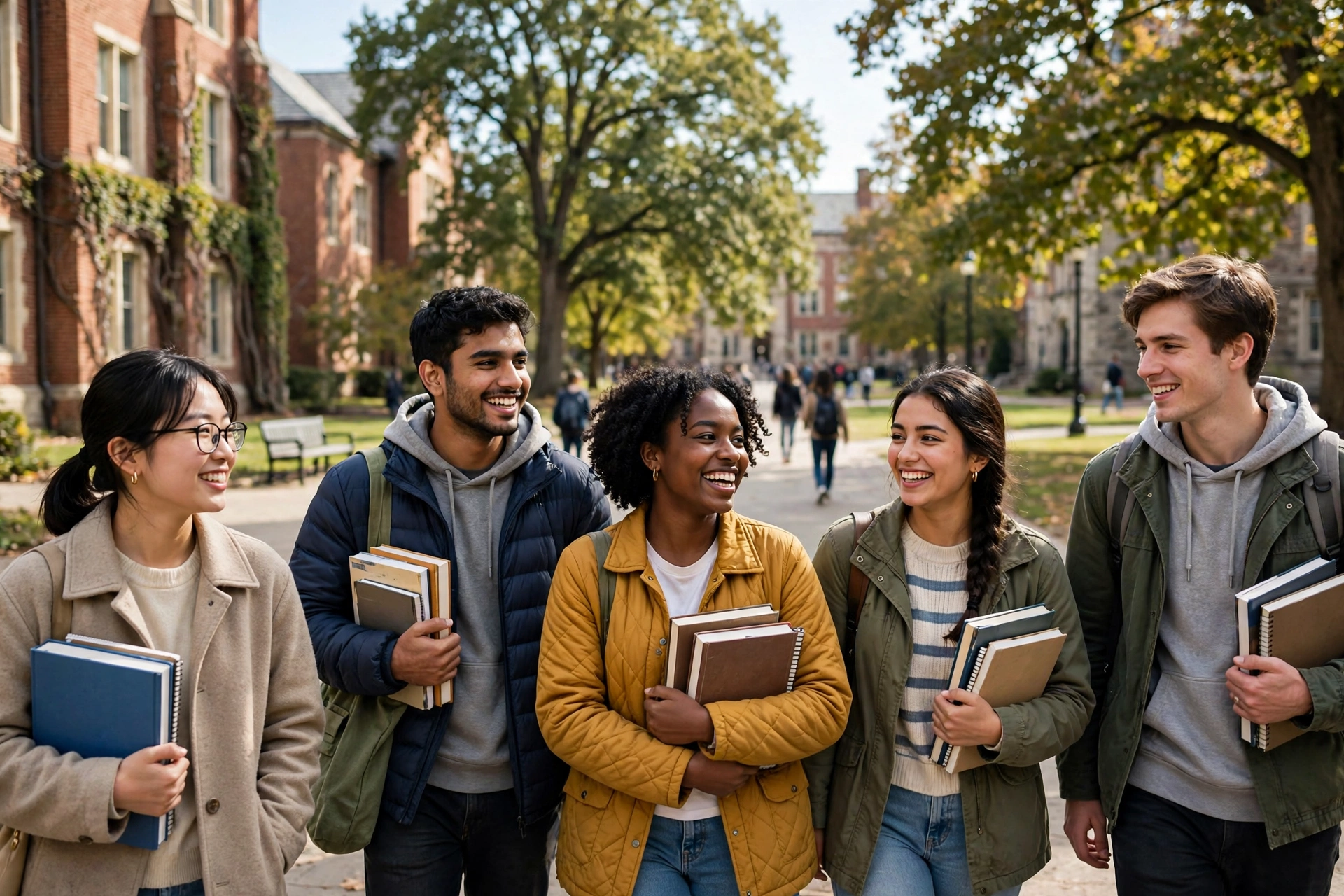
To study in USA in 2026 is one of the most popular choices for international students who want a world-class education, strong career prospects, and a life-changing experience abroad. Every year, more than one million international students choose to study in USA, and the United States remains home to more top-ranked universities than any other country in the world. From Ivy League institutions and large public research universities to small liberal arts colleges and specialist technology schools, the USA offers a degree for almost every subject, budget, and ambition.
This complete guide explains how to study in USA in 2026, step by step. You will learn why so many students choose the United States, which universities are best for international students, how much it really costs, how the F-1 student visa works, what documents you need, how to find scholarships, and how to work while you study. Whether you want a bachelor’s degree, a master’s degree, or a PhD, this guide will help you plan with confidence and avoid the most common mistakes.
Why Study in USA in 2026?
There are many reasons to study in USA. American universities are known for academic freedom, flexible degree programs, modern research facilities, and close links with employers. Most undergraduate degrees in the USA allow you to explore different subjects in your first year before you choose a major, so you do not have to decide your whole career at the age of 17 or 18. At graduate level, American universities offer advanced laboratories, large libraries, and the chance to work with leading researchers in your field.
A degree from the USA is respected by employers around the world. American universities regularly lead global rankings, and their graduates work in technology, finance, medicine, engineering, business, law, media, and public service in almost every country. Studying in the USA also improves your English, builds an international network of friends and contacts, and teaches you independence, confidence, and problem-solving skills that employers value highly.
- World-leading universities: The USA has more universities in the top 100 of global rankings than any other country.
- Flexible study: You can change your major, take courses in different subjects, and combine subjects in ways that are not possible in many other systems.
- Research and innovation: American universities invest heavily in research, internships, and new technology.
- Career opportunities: Optional Practical Training (OPT) lets many graduates work in the USA after their degree.
- Diverse campuses: Universities in the USA welcome students from every background, with clubs, societies, sports, and support services for international students.
- English-language environment: Studying in English every day builds fluency that helps your career for life.
In 2026, the USA continues to attract students in computer science, engineering, business, data science, health sciences, and the arts. If you want a degree that opens doors worldwide, few destinations can match the choice, quality, and reputation of American higher education.
Best Universities in USA for International Students in 2026
Choosing where to study in USA is one of the most important decisions you will make. The best university for you is not always the most famous one. It is the one that offers the right course, the right support, and a cost you can manage. Some students want a large research university in a big city, while others prefer a smaller campus, a strong scholarship, or a university known for one subject.
Top universities to study in USA in 2026
Harvard University, the Massachusetts Institute of Technology (MIT), Stanford University, the California Institute of Technology, Princeton University, Yale University, Columbia University, and the University of Chicago are among the most famous universities in the world. They are highly selective, with acceptance rates often below 10 percent, and they offer generous financial aid to many admitted students. Public universities such as the University of California, Berkeley, the University of California, Los Angeles (UCLA), the University of Michigan, and the University of Texas at Austin also rank among the best in the world and often cost less than private universities, especially for students who qualify for scholarships.
For a full comparison of rankings, tuition, acceptance rates, and admissions, read our guide to the best universities in USA 2026. It will help you build a shortlist that matches your grades, test scores, budget, and career goals.
How to choose the right university to study in USA
Start by listing the subjects you want to study, then look for universities that are strong in those subjects. Check the total cost, including tuition, housing, food, and health insurance, and look at the scholarships each university offers to international students. Think about location too. A university in New York or California may offer more internships but higher living costs, while a university in a smaller city may be cheaper and offer a closer community. Look at graduation rates, employment outcomes, and the support services for international students, including visa advice, English-language help, and career services. Finally, apply to a mix of ambitious, realistic, and safe choices, so you have options when decisions arrive.
Cost of Studying in USA in 2026
The cost to study in USA in 2026 varies widely by university type, location, and degree level. Public universities usually charge less than private universities, and community colleges are the cheapest way to start a bachelor’s degree. Graduate tuition is often higher than undergraduate tuition, especially for professional degrees in medicine, law, and business. Before you apply, always check the official cost of attendance for each university, because that figure includes tuition, fees, housing, food, books, transport, and health insurance.
Tuition fees to study in USA
For 2026, undergraduate tuition at a public four-year university is typically about $11,000 to $25,000 per year for in-state students, and about $25,000 to $45,000 per year for international students, who usually pay the out-of-state rate. Private universities commonly charge $40,000 to $65,000 per year in tuition alone. Community colleges can cost $8,000 to $15,000 per year for international students, which makes them a smart first step for many students who later transfer to a four-year university. Master’s degrees usually cost $20,000 to $60,000 per year, depending on the subject and the university.
Living costs while you study in USA
Living costs depend on where you live. Housing on campus usually costs $10,000 to $18,000 per year, including a meal plan in many cases. Renting off campus can be cheaper in a small town and much more expensive in New York, San Francisco, Boston, or Los Angeles. Food, transport, books, supplies, and personal expenses typically add $5,000 to $10,000 per year. Health insurance is compulsory for most international students and usually costs $1,500 to $3,500 per year. You should budget at least $15,000 to $25,000 per year for living costs, on top of tuition.
Total cost to study in USA: comparison table
| Type of university | Tuition per year | Living costs per year | Total per year |
|---|---|---|---|
| Community college | $8,000 – $15,000 | $12,000 – $18,000 | $20,000 – $33,000 |
| Public four-year university | $25,000 – $45,000 | $15,000 – $22,000 | $40,000 – $67,000 |
| Private university | $40,000 – $65,000 | $18,000 – $25,000 | $58,000 – $90,000 |
| Master’s degree | $20,000 – $60,000 | $15,000 – $25,000 | $35,000 – $85,000 |
These are typical ranges for 2026, not exact prices. Always confirm the current figures on each university website. Scholarships, assistantships, and part-time work can reduce the amount you actually pay, and many students combine several sources of funding. If the total cost looks high, remember that a degree from the USA can lead to strong salaries, especially in technology, engineering, finance, and healthcare. If you need to borrow, read our guide to a student loan in USA 2026 to understand federal and private options, rates, and repayment before you commit.
Student Visa in USA: F-1 Visa Process Step-by-Step
Most international students who study in USA need an F-1 student visa. The F-1 visa is for full-time academic study at an accredited school, college, or university in the United States. You cannot apply for the visa until a university has accepted you and issued a Form I-20, which is the certificate of eligibility for nonimmigrant student status. The process takes time, so start as soon as you receive your I-20 and do not book non-refundable travel until your visa is approved.
- Get accepted and receive your Form I-20. Apply to universities, accept an offer, and pay any required deposit. The university will then send your I-20, which lists your program, start date, and estimated costs.
- Pay the SEVIS fee. Pay the SEVIS I-901 fee online and keep the receipt. SEVIS is the system that tracks international students in the USA, and the fee is currently $350 for F-1 students.
- Complete the DS-160 form. Fill in the online nonimmigrant visa application form, DS-160, and print the confirmation page with its barcode.
- Pay the visa application fee and book your interview. The F-1 visa application fee is $185. Book an interview at the nearest U.S. embassy or consulate and choose a date well before your course starts.
- Prepare your documents. Take your passport, I-20, DS-160 confirmation, SEVIS fee receipt, visa fee receipt, admission letter, financial evidence, academic transcripts, test scores, and a recent photograph.
- Attend the visa interview. Answer questions honestly and clearly about why you want to study in USA, why you chose your university and course, how you will pay for it, and your plans after graduation. The officer must be convinced that you are a genuine student and that you will return home after your studies, unless you later qualify for another lawful status.
- Receive your visa and prepare to travel. If approved, your passport will be returned with the F-1 visa. You can enter the USA up to 30 days before the start date on your I-20.
Visa interviews are usually short, often less than five minutes, so prepare concise answers. Practice explaining your study plans in your own words, know the name of your university and course, and be ready to show how you will fund your studies. Never use false documents or give false information, because that can lead to a refusal and a long-term ban. If your visa is refused, read the reason carefully, fix the problem, and consider applying again with stronger evidence.
How to Apply to Study in USA in 2026
The application process to study in USA takes planning, because deadlines are often 8 to 12 months before the course starts. Most students apply in the autumn for a fall start in August or September, although many universities also offer a spring start in January. Start early, keep a checklist, and track every deadline in one place.
- Research and shortlist universities. Choose 6 to 10 universities that fit your subject, grades, and budget.
- Check entry requirements. Note the required grades, English test scores, and any subject-specific requirements for each university.
- Take English and admissions tests. Many universities ask for IELTS, TOEFL, or Duolingo English Test scores. Some also accept SAT or ACT scores for undergraduate entry, and GRE or GMAT scores for some graduate programs, although many programs are now test-optional.
- Prepare your documents. Gather transcripts, certificates, test scores, a passport copy, and financial evidence.
- Write your personal statement and essays. Explain why you want to study your subject, what you have learned so far, and what you hope to do after graduation.
- Request recommendation letters. Ask teachers or employers who know you well, and give them at least four weeks to write.
- Submit your applications. Many undergraduate applications go through the Common Application, while graduate applications are usually made directly on each university website. Pay the application fee, usually $50 to $100 per university, or request a fee waiver if you qualify.
- Attend interviews if invited. Some universities interview shortlisted applicants by video call.
- Compare offers and accept one. Once you have your offers, compare costs, scholarships, and courses before you accept and request your I-20.
Documents needed to study in USA
- Valid passport
- Academic transcripts and certificates from school or previous university
- English-language test results, such as IELTS or TOEFL
- SAT, ACT, GRE, or GMAT scores, if required
- Personal statement or essays
- Two or three recommendation letters
- Resume or CV, especially for graduate and MBA programs
- Financial evidence, such as bank statements or a sponsor letter, showing you can pay tuition and living costs
- Portfolio or writing samples, if your course requires them
Check every document carefully before you submit it. Names, dates, and grades must match your passport and transcripts exactly. Translate any document that is not in English through a certified translator, and keep copies of everything you send.
Scholarships and Financial Aid to Study in USA in 2026
Scholarships can make it possible to study in USA even when the headline cost looks high. Many universities offer merit scholarships based on grades and test scores, need-based aid based on family income, and scholarships for specific subjects, sports, or talents. Some universities meet the full financial need of admitted international students, while others offer partial awards of $5,000 to $30,000 per year. Graduate students can also apply for teaching assistantships and research assistantships, which often include a tuition waiver and a monthly stipend in exchange for teaching or research work.
Government and private scholarships are also available. Well-known programs include Fulbright scholarships, university-specific international scholarships, and awards from foundations and employers. Deadlines for scholarships are often earlier than admission deadlines, so apply as soon as applications open. For a detailed list of programs, eligibility rules, and deadlines, read our guide to scholarships in USA for international students 2026.
To improve your chances, apply to several scholarships, tailor each application to the award, and write clearly about your achievements and goals. Ask your university financial aid office what aid is available to international students, because some aid is only open to U.S. citizens and permanent residents. Never pay an agent who promises a guaranteed scholarship, and never pay a large fee to apply for a free scholarship program.
Work While Studying in USA: On-Campus Jobs, CPT, and OPT
Many students who study in USA also want to work part-time to gain experience and help with living costs. F-1 students have clear rules about work, and breaking them can put your visa status at risk, so understand the rules before you start any job.
On-campus work while you study in USA
F-1 students can usually work on campus for up to 20 hours per week during term time and full-time during holidays. On-campus jobs include work in the library, dining hall, student office, research lab, or as a teaching assistant. Pay is often $10 to $20 per hour, depending on the state and the job. These jobs are a good first step because they do not need extra authorization beyond your F-1 status, but you should still check with your university international office before you start.
Curricular Practical Training (CPT)
Curricular Practical Training, or CPT, lets F-1 students work in an internship or job that is part of their degree program. CPT must be approved by your university and recorded on your I-20 before you start. It is common for internships in business, engineering, and computer science, and it is one of the best ways to gain U.S. work experience while you study. Full-time CPT for 12 months or more can affect your eligibility for OPT, so ask your international office before you accept a long full-time placement.
Optional Practical Training (OPT)
Optional Practical Training, or OPT, lets F-1 students work in the USA in a job related to their field of study. Most students use OPT after graduation, for up to 12 months. Graduates in science, technology, engineering, and mathematics (STEM) can often extend OPT by a further 24 months, giving up to 36 months of work in total. You must apply for OPT through U.S. Citizenship and Immigration Services and receive your Employment Authorization Document before you start work. Apply early, because processing can take several months, and plan your job search while you are still studying.
Life as an International Student in USA
Life as an international student in USA is about much more than classes. Most universities have hundreds of clubs for sports, music, volunteering, culture, and academic interests, and joining one is the fastest way to make friends. Campus housing helps you meet other students, while orientation programs, international student offices, and buddy schemes help you settle in during your first weeks. American campus life is often busy and social, with sports events, festivals, and student activities throughout the year.
Everyday life takes some adjustment. You will need a U.S. bank account, a local SIM card, and a Social Security number if you work on campus. Public transport varies by city, so check how students travel in your area. Food, weather, and academic expectations can all feel different at first, and homesickness is normal. Most universities offer free counselling, health services, and academic support, so ask for help early if you need it. Learning to manage your money, cook simple meals, and plan your week will make student life much easier.
Tips to Get Admitted to Study in USA
- Start early: Begin research at least a year before your planned start date.
- Show your story: Use essays to explain your interests, achievements, and goals in your own words.
- Prepare for English tests: Practice regularly and book your test early so you can retake it if needed.
- Choose recommenders carefully: Pick people who know your work and can give specific examples.
- Apply to a balanced list: Include ambitious, realistic, and safer universities.
- Check scholarships first: Some aid deadlines close before admission deadlines.
Mistakes to Avoid When You Study in USA
- Missing deadlines: Late applications and scholarship forms are usually not accepted.
- Applying only to famous universities: A strong fit matters more than a famous name.
- Ignoring the total cost: Always budget for housing, insurance, books, and travel, not just tuition.
- Working without authorization: Off-campus work without permission can endanger your F-1 status.
- Leaving the visa too late: Book your interview as soon as you have your I-20.
- Copying essays: Universities check for plagiarism, so write in your own words.
FAQs About How to Study in USA in 2026
How much does it cost to study in USA in 2026?
Most international students pay $40,000 to $90,000 per year in total, including tuition and living costs. Community colleges and public universities are usually cheaper, and scholarships can reduce the cost a great deal.
How long does it take to get an F-1 student visa?
After your interview, many visas are approved within a few days, but interview waiting times vary by embassy. Apply as soon as you receive your I-20 and allow at least two to three months before your course starts.
Can international students work while they study in USA?
Yes. F-1 students can work on campus for up to 20 hours per week during term time, and they can use CPT for internships and OPT for work after graduation, with the right authorization.
Do I need IELTS to study in USA?
Most universities ask for proof of English, usually IELTS, TOEFL, or the Duolingo English Test. Some universities waive the test if you studied in English before, so check each university policy.
When should I apply to study in USA in 2026?
Apply 8 to 12 months before your course starts. For a fall 2026 start, most deadlines fall between November 2025 and February 2026, with scholarship deadlines often earlier.
Final Thoughts on How to Study in USA in 2026
To study in USA in 2026 is a big decision, but it is also one of the best investments you can make in your education and career. Choose your universities carefully, plan your costs and scholarships early, prepare strong applications, and follow the F-1 visa steps in order. With the right preparation, you can join more than a million international students who study in USA every year and build a future that starts on an American campus.
Useful Resources for Students Who Want to Study in USA
Before you apply to study in USA, check the current visa rules, interview wait times, and program details on the official U.S. Department of State student visa page. Use it alongside the guides on this site to plan your application, your budget, and your move to the United States.
Pingback: MBA in USA 2026 – Best Business Schools, Fees & Salary After MBA - jobsgoro.com
Pingback: Cheapest Universities in USA 2026 – Low Tuition Colleges for International Students - jobsgoro.com
Pingback: Jobs in USA for Foreigners 2026 – Best Visa Sponsorship, Salary & How to Apply